
In the world of cooking and baking, knowing your measurement conversions is more than just helpful—it’s essential. Recipes often call for ingredients in one type of measure while your available tools might be in another. This mismatch can lead to imprecise results: too much liquid, too little flour, inconsistent textures. That’s why understanding culinary measurement relationships is so important.
There are many situations where you’ll need to convert tablespoons into cups: adjusting a recipe for a larger or smaller yield, substituting kitchen utensils because you don’t have the exact measure called for, or interpreting an older cookbook that uses a measurement standard you’re less familiar with. Even experienced cooks sometimes get tripped up by measurement tables—especially when they switch between metric vs. imperial, or between countries with slightly different standards.
This article will focus on one specific conversion that often comes up: tablespoons to cups. We’ll explain the direct relationship, provide conversions for typical measures (with attention to regional variations in the US, UK, Canada and Australia), show how to visualise what a tablespoon looks like in a cup, explore why volumes can differ between countries, discuss when this knowledge becomes critical, and provide practical tips for more reliable measuring in the kitchen.
The Basic Relationship
Here is the straightforward answer many seek when they ask “how many cups in a tablespoon?”
✅ 1 tablespoon = 1/16 cup
✅ Inversely, 16 tablespoons = 1 cup
Put simply, if you have a recipe that calls for 16 tablespoons of a liquid or ingredient and you want to use a one-cup measure instead, you’re in alignment. The 1/16 ratio is the key conversion factor.
In more numeric terms (for a typical US standard cup):
1 tablespoon ≈ 0.0625 cup (because 1 ÷ 16 = 0.0625)
So when you see “1 tbsp” you can think “roughly 0.0625 of a cup”.
Of course, in practice you won’t always deal with perfect decimal values, but the 1/16 ratio gives you a dependable rule of thumb.
Quick Conversion Table (for US, UK, Canada & Australia)
Here’s a quick-reference table for common tablespoon-to-cup conversions. These assume the basic 1 tbsp = 1/16 cup ratio for a standard cup measure. Actual millilitre values may differ slightly by country (we’ll discuss that in section 5).
Tablespoons (tbsp) | Cups (US standard) |
|---|---|
1 tbsp | 1/16 cup (≈ 0.0625) |
2 tbsp | 1/8 cup (≈ 0.125) |
4 tbsp | 1/4 cup (≈ 0.25) |
8 tbsp | 1/2 cup (≈ 0.5) |
16 tbsp | 1 cup (≈ 1.0) |
This simple table covers many everyday conversions you’ll need when scaling recipes up or down using tablespoons and cups.
Visual Comparisons
When you’re in the kitchen, it helps to see what these volumes look like rather than just memorising numbers.
Here are a few key points about visualising and measuring:
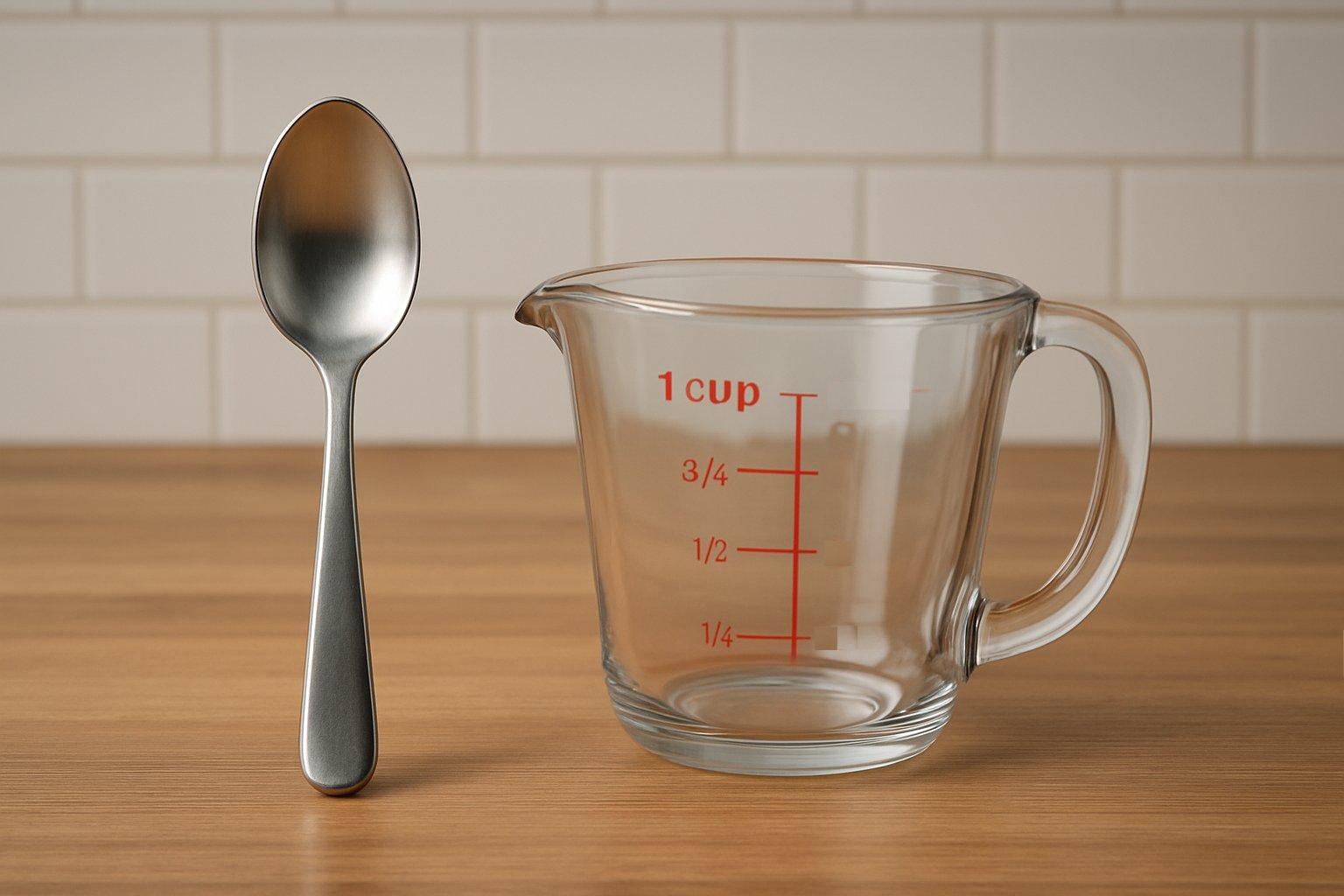
A single tablespoon is quite a small portion of a standard cup—just one-sixteenth of its volume. That means you’d need sixteen of those spoonfuls to fill the cup.
Visualising one tablespoon in a cup helps you see how small or large relative amounts are when you scale. This is especially helpful when dividing or multiplying a recipe.
Volumetric measuring (cups, tablespoons) is far better than “eyeballing” or using generic spoons from your cutlery drawer. Generic spoons vary widely in size, and the error compounds when you pour ingredients by sight rather than measure.
A useful kitchen tip: when measuring with a tablespoon measure, fill it level to the rim (use a straight-edge like the back of a knife) rather than mound it. That way, you preserve more accurate volume rather than inadvertently adding excess.
Using visuals and consistent technique helps you achieve reliable results—especially in baking, where precise proportions matter significantly.
Differences Across Countries (US, UK, Canada & Australia)
One complicating factor in conversions is that “tablespoon” and “cup” do not always mean the exact same millilitre volume everywhere. The 1/16 cup ratio is correct when both tablespoon and cup are defined consistently—but countries’ definitions differ.
Here are some key national standards:
In the United States, one tablespoon is defined as 14.79 mL (by common convention).
In the United Kingdom, one tablespoon is typically defined as 15 mL.
In Australia, one tablespoon is 20 mL (yes, significantly larger).
Because of these differences, if you use a tablespoon-to-cup conversion derived from US cup volumes but then your tablespoon is defined differently, there can be subtle (or not so subtle) discrepancies in actual quantities.
For example, if you follow a recipe from Australia and it calls for “1 tbsp”, you might be dealing with 20 mL rather than 14.8 mL. Similarly, the “cup” size might differ slightly in some national conventions. That means while the ratio 1 tbsp = 1/16 cup holds as a mathematical simplification, the underlying volumes of the “tablespoon” and “cup” may vary by region—and so the actual millilitre volumes differ.
In short: when converting or scaling recipes, it helps to know which regional standard you are using (US vs. UK vs. Australian) in order to avoid unexpected results.
When This Knowledge Is Necessary
Why is knowing 1 tablespoon = 1/16 cup (and the regional nuance) practically important? Here are scenarios where it really matters:
Scaling recipes up or down. Suppose a recipe yields 8 servings but you want to make enough for 12. If the original calls for tablespoons of an ingredient and you want to convert to cups for convenience (or vice versa), you’ll need to understand the ratio.
When you don’t have a measuring cup at hand. If you only have measuring spoons (tablespoons) but the recipe gives cups, you’ll rely on converting to tablespoons (or the reverse) so you can use what you have.
Impromptu substitutions or improvisation. Maybe you’re halfway through a recipe and decide to double it—but you only have a cup measure. Knowing how many tablespoons fill a cup (16) can save you from guess-work.
Working with international recipes. You might find a recipe from a region whose “tablespoon” or “cup” differs from yours. Being aware that tables and cups vary helps you interpret the ingredient quantities properly.
Avoiding mis-measuring in baking. Especially in baking (versus more forgiving cooking), small errors in measurement propagate and affect texture, rise, moisture, etc. Using the correct conversion helps maintain the balance of dry vs. wet ingredients.
In all these cases, understanding the tablespoon-to-cup relationship simplifies measurement decisions and helps maintain recipe integrity.
Tips for Convenient Measuring
While this article isn’t about giving specific product recommendations, here are some sensible practices to make your measuring smoother and more reliable:
Keep a set of standard measuring spoons and a measuring cup clearly marked and calibrated for the region you cook in. When you switch between recipes from different countries, note the measurement standard being used.
Consider using an online conversion tool or a smartphone-note cheat sheet where you have the quick conversion table (like the one above) handy.
Remember that a proper measuring tablespoon (designed for volume) is not the same as the tablespoon you use at the dinner table. Dinner-table spoons vary widely and are unreliable for recipe precision.
When measuring, fill to the rim (for liquids) or level off (for dry ingredients) rather than pouring loosely. This reduces variation. For dry ingredients, be wary of compacting and over-filling.
If you are adjusting a recipe by a factor (for example, doubling or halving), use the tablespoon-cup relationship early in your calculation rather than waiting until the end. That way you preserve the correct proportion across all ingredients.
By adopting these habits, you reduce the potential for mis-measuring, especially when the recipe hasn’t been adapted by you before.
Conclusion
In summary: when using standard US-based measurements, 1 tablespoon = 1/16 cup. That means 16 tablespoons equal 1 cup. While the basic mathematical relationship holds as a general rule, you should be aware that actual volumes for “tablespoon” and “cup” vary between countries (US, UK, Australia, Canada), so always check the context of the recipe.
Accuracy in measuring is a key factor in cooking and baking success. Whether you’re scaling a recipe, measuring without the exact tool, or following a recipe from a different region—knowing how tablespoons relate to cups gives you foundational confidence in your kitchen conversions. Precision doesn’t have to mean perfection—but it does mean consistency. And consistency is what helps yield reliably good results.