
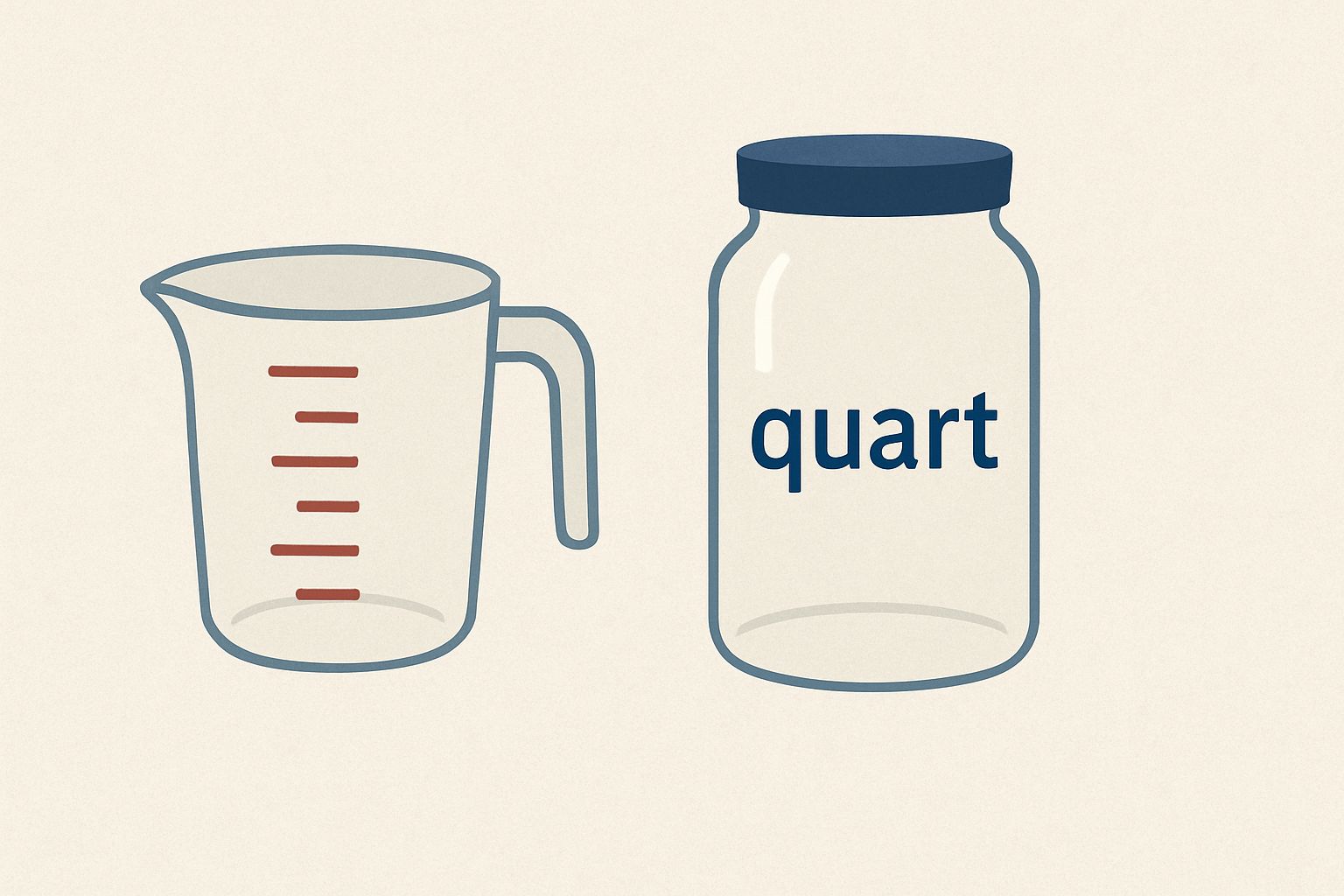
Cooking may be an art, but it relies heavily on precision. A little too much liquid in a custard can ruin its texture, and too little milk in a bread dough can alter the rise. Recipes are written with certain measurement standards in mind, and those standards depend on where the recipe originated.
The challenge is that the same words — cup, pint, quart — don’t always translate directly between systems. For example, a British quart is not the same as an American quart. The same goes for the size of a cup, and even the fluid ounce has two meanings depending on whether you’re in London or Los Angeles.
Knowing the conversion isn’t about memorizing numbers; it’s about avoiding the small inconsistencies that can add up to big differences in the final result. It’s especially important for liquid ingredients — milk, broth, cream, oil — where density doesn’t change much and volume measurements are common.
Quick Answer for the United States
Let’s start with the simple question:
How many cups are in a quart in the U.S.?
In the U.S. Customary System, the relationship is straightforward:
1 quart = 4 cups
1 cup = 8 U.S. fluid ounces
That means a quart equals 32 fluid ounces in total. In metric terms, a U.S. cup holds approximately 240 milliliters, so a quart equals about 946 milliliters.
This is the standard used across the United States for cooking, packaging, and most liquid measurements. When you see recipes online that just say “1 cup milk” without any clarification, they’re almost always referring to this U.S. Customary measurement.
Comparing Measurement Systems: U.S., Canada, UK, and Australia
Now things start to get interesting. Though all four countries use the term “quart,” their systems diverge — sometimes significantly.
Here’s a comparative overview:
Country | 1 Quart Equals | 1 Cup Equals | Measurement System |
|---|---|---|---|
United States | 4 cups | 240 ml (approx.) | U.S. Customary |
Canada | 4 cups (metric) | 250 ml | Metric + Imperial blend |
United Kingdom | 4 cups (Imperial) | 284 ml | British Imperial |
Australia | 4 cups | 250 ml | Metric |
At first glance, you might think all these systems align — after all, it’s always four cups in a quart. But the volume of each cup varies, and that’s what causes confusion. A British or Imperial cup is larger than a U.S. cup, and a metric cup (used in Canada and Australia) sits somewhere in between.
This means that even though “4 cups = 1 quart” remains consistent in form, the actual total volume changes depending on where you are.
Why the Difference Exists
The story of these measurement differences is one of history, empire, and gradual standardization.
1. The Divergence Between Imperial and U.S. Customary
Both the British Imperial and U.S. Customary systems trace their roots back to pre-19th-century England. However, when the U.S. formalized its standards in the early 1800s, it adopted the old English wine gallon as its liquid base unit.
Later, in 1824, Britain redefined its liquid measurements based on the volume of ten pounds of water at a specified temperature, creating the Imperial gallon. As a result, the British gallon became about 20% larger than the U.S. gallon. That difference carried down to smaller units — pints, quarts, and cups.
So while both systems share familiar names, they represent distinct physical volumes. The same applies to ounces: one U.S. fluid ounce is roughly 29.57 milliliters, while one Imperial fluid ounce is about 28.41 milliliters.
2. Canada and Australia’s Metric Transitions
In the 1970s, both Canada and Australia began transitioning officially to the metric system, aligning with global standards and simplifying trade. But in kitchens, the traditional terms — cup, pint, quart — lingered on.
Today, both countries use metric cups of 250 milliliters, maintaining the traditional terminology but basing it on a round metric value. In everyday cooking, a “cup” in Canada or Australia almost always refers to this 250 ml standard.
However, some Canadian recipes, especially older ones or those adapted from the U.S., still use the U.S. Customary cup (240 ml). That dual usage makes Canada a hybrid system in practice — metric officially, but with strong historical Imperial and U.S. influences.
Kitchen Examples: When a Cup Isn’t a Cup
Let’s make the differences tangible. Imagine you’re following an American recipe calling for 2 cups of milk. In the U.S. system, that’s about 480 milliliters.
Now, if a British cook measures out 2 cups using Imperial cups (284 ml each), they’ll end up with 568 milliliters — nearly 90 ml more milk, or about 19% extra. That could noticeably affect the texture of a sauce or custard.
Likewise, if an Australian cook uses two metric cups (250 ml each), the total will be 500 ml, slightly more than the American version but less than the British one.
Here’s a visual sense of how those small differences add up:
Country | 2 Cups (Milk) | Approx. Volume |
|---|---|---|
U.S. | 2 × 240 ml | 480 ml |
Canada (metric) | 2 × 250 ml | 500 ml |
UK (Imperial) | 2 × 284 ml | 568 ml |
Australia | 2 × 250 ml | 500 ml |
So even though the recipes use identical terminology, they yield slightly (or significantly) different results depending on the measuring standard behind them.
This is why professional chefs and bakers tend to prefer metric units — not because they dislike traditional ones, but because precision matters when scaling recipes or reproducing results globally.
Conversion Table for Reference
Here’s a broader comparison of common liquid measures across the four regions:
Unit | United States | United Kingdom | Canada | Australia |
|---|---|---|---|---|
1 cup | 240 ml | 284 ml | 250 ml | 250 ml |
1 pint | 473 ml | 568 ml | 500 ml | 500 ml |
1 quart | 946 ml | 1,137 ml | 1,000 ml | 1,000 ml |
1 gallon | 3,785 ml | 4,546 ml | 4,000 ml | 4,000 ml |
Notice how the Imperial system yields slightly larger quantities across the board. The U.S. quart, for instance, is about 946 milliliters, while the British quart is 1.137 liters — a difference of nearly 200 ml.
Why These Distinctions Still Matter
Even in an age where digital scales and metric conversions are widely available, regional differences in measurement persist — not only out of habit but also out of cultural tradition.
1. Legacy in Recipe Books
Classic cookbooks in the U.S. and UK still use their native systems, and many home cooks have measuring cups marked in local units. In Canada, you’ll find older recipes mixing Imperial pints with metric liters in the same paragraph. This legacy makes historical context important: when a recipe was written often determines which system it uses.
2. Global Recipe Sharing
Online food culture has blurred geographic boundaries. Recipes circulate globally through blogs, videos, and social platforms. But unless measurements are clearly stated, a recipe from Texas might mislead a cook in Toronto or London.
Understanding conversion standards helps cooks interpret recipes correctly — not to change the cuisine, but to preserve its intended proportions.
3. Packaging and Labeling
Product labeling (for items like milk or broth) can also differ. In the U.S., fluid ounces and quarts dominate; in Australia and Canada, milliliters and liters are standard. The visual cues might look familiar, but the volumes can subtly differ.
Historical Context: The Evolution of the “Quart”
The word quart originates from the Latin quartus, meaning “fourth.” A quart represents one-quarter of a gallon. But as noted earlier, not all gallons are equal.
Before standardization, local trade measured liquids differently depending on the commodity — wine, ale, or grain each had its own “gallon.” The U.S. gallon derived from the Queen Anne wine gallon (231 cubic inches), while the British Imperial gallon came later, defined by water weight.
When the British updated their system in 1824, the U.S. had already codified its older one, leading to the parallel but inconsistent systems we have today.
In Canada and Australia, Imperial units dominated colonial-era trade and daily life. When the metric system was introduced in the 20th century, the familiar terms were retained for household use, creating hybrid identities: a “quart” that’s conceptually the same fraction (a fourth of a gallon) but tied to the metric liter instead.
Common Questions (FAQ)
Can I use any household cup to measure ingredients?
Not reliably. Everyday cups and mugs vary dramatically in volume — some hold 200 ml, others 400 ml or more. True “cup” measurements refer to standardized measuring cups specific to a given system. Using random kitchenware risks inaccuracy, especially for liquids.
What’s the difference between an Imperial cup and a U.S. cup?
An Imperial cup equals 284 milliliters, while a U.S. cup equals 240 milliliters. That 44-milliliter gap may sound minor, but in a recipe calling for multiple cups of liquid, it can lead to meaningful variation in texture or consistency.
Why does Canada have two systems?
Canada officially adopted the metric system in the 1970s, but Imperial and U.S. measurements remained common in households and certain industries. Cookbooks, television shows, and imported recipes often use different standards. As a result, Canadians frequently move between the metric (250 ml cup) and U.S./Imperial conventions depending on context.
Does Australia still use cups and quarts?
Australia transitioned fully to the metric system, but the culinary world retained “cups” as a convenient and familiar term. However, the Australian cup is defined as 250 milliliters, consistent with the metric standard. Quarts and pints are largely historical in modern Australian recipes.
Why not just switch everything to milliliters?
While metric measures are globally standardized, traditional units carry cultural and practical familiarity. Many home cooks visualize “a cup of flour” more intuitively than “250 milliliters of flour.” Moreover, dry ingredients vary in density, so metric weight (grams) is often better for precision, while volume remains intuitive for liquids and quick cooking.
How to Avoid Confusion in Practice
Even though this isn’t about giving recommendations, one practical takeaway from understanding these systems is simple awareness. Whenever you see “cup,” “pint,” or “quart” in a recipe, think of it as a context-dependent term, not an absolute.
Ask yourself:
Where does this recipe come from?
Which measurement standard is it likely using?
Are you translating between Imperial, U.S., or metric values?
Awareness of these distinctions can help prevent underfilled batters, overly thin sauces, or dense baked goods — not by changing your recipe, but by aligning your measurements with its intended system.
Broader Perspective: Beyond Cooking
Though most people encounter cups and quarts in the kitchen, these measurement variations extend into other fields. In chemistry, manufacturing, and trade, accurate volume conversion is fundamental. Globalization has made metric the international scientific and commercial standard, yet traditional units survive in cultural and everyday contexts.
This duality — scientific precision versus cultural habit — is part of what makes measurements fascinating. They reveal not only physical quantities but also how societies preserve and adapt their histories through language and practice.
Final Thoughts
At first glance, “How many cups are in a quart?” sounds like a simple question with a single answer. But as we’ve seen, it depends entirely on where you are.
In summary:
Country | Cups per Quart | Cup Volume | Quart Volume |
|---|---|---|---|
U.S. | 4 | 240 ml | 946 ml |
Canada | 4 | 250 ml | 1,000 ml |
UK | 4 | 284 ml | 1,137 ml |
Australia | 4 | 250 ml | 1,000 ml |
The takeaway is not that one system is better than another — each reflects a distinct historical path. The key is recognizing that these differences exist. A “cup” or “quart” isn’t universal; it’s a cultural expression of measurement that has evolved alongside language and trade.
In the age of global recipes and international audiences, understanding these subtleties keeps our kitchens harmonious and our results consistent. Whether you’re whisking batter in Boston, baking scones in London, simmering soup in Vancouver, or brewing coffee in Sydney, knowing how your “cup” and “quart” measure up connects you to a shared culinary story — one that spans centuries and continents.