Accurate measurement is one of the quiet foundations of successful cooking and baking. Behind every beautifully risen cake, perfectly seasoned sauce, or delicately balanced dressing lies a hidden network of ratios, conversions, and tiny differences that can make or break a recipe. Among these small but mighty details is a deceptively simple question: How many teaspoons are in a tablespoon?
It sounds straightforward, but as soon as you step beyond your local kitchen and start exploring recipes from different countries, things can get complicated. This single conversion—tablespoon to teaspoon—is one of the most commonly needed in culinary work worldwide, yet it’s also one of the most misunderstood.
Let’s unpack why that is, how it varies by country, and why these seemingly tiny numbers matter so much in the kitchen.
The Importance of Accurate Measurements
Cooking can often feel intuitive—add a pinch of this, a splash of that—but baking, sauces, custards, and other precision-based recipes depend heavily on ratios. One extra teaspoon of oil in a dressing may not ruin it, but one extra teaspoon of baking powder could completely alter the texture of a cake.
Tablespoons and teaspoons are among the most frequently used units in cooking. They’re used to measure ingredients that don’t justify the bulk of a cup—things like spices, extracts, oils, or leavening agents. When these are measured incorrectly, the results can be subtle or dramatic depending on what you’re making.
That’s why understanding the relationship between tablespoons and teaspoons is not just a matter of curiosity—it’s essential for anyone who wants consistent results, especially when translating recipes across borders.
Quick Answer: Tablespoon to Teaspoon Conversion
Here’s the short version before we dive into the details:
Region | 1 Tablespoon = ? Teaspoons | Milliliters (mL) | Fluid Ounces (fl oz) |
|---|---|---|---|
🇺🇸 U.S. & Canada | 3 teaspoons | 14.79–15 mL | 0.50 fl oz |
🇦🇺 Australia | 4 teaspoons | 20 mL | 0.68 fl oz |
🇬🇧 United Kingdom | 3 teaspoons | 15 mL | 0.51 fl oz |
✅ In the U.S. and Canada:
1 tablespoon = 3 teaspoons
✅ In Australia:
1 tablespoon = 4 teaspoons
✅ In the U.K.:
1 tablespoon = 3 teaspoons (with nuances, especially in older recipes)
This difference might seem small—after all, what’s one extra teaspoon? But when you’re working with emulsions, doughs, or chemical leaveners, even a few milliliters or fractions of a fluid ounce can change the chemistry of your dish.
Differences by Country: A Detailed Breakdown
Let’s take a closer look at how these conversions differ depending on where you are.
🇺🇸 United States
The U.S. uses the Customary Measurement System, which defines:
1 tablespoon (tbsp) = 14.79 milliliters (mL) = 0.50 fluid ounces (fl oz)
1 teaspoon (tsp) = 4.93 milliliters (mL) = 0.17 fluid ounces (fl oz)
That gives a clean conversion:
1 tablespoon = 3 teaspoons
This standard is widely used across American cookbooks, recipe websites, and packaged food labeling. U.S. measuring spoons are produced according to this ratio, making it one of the most consistent systems in practice.
🇨🇦 Canada
Canada officially follows the metric system, but in practice, it straddles two worlds. Many Canadian recipes—especially those with North American roots—still rely on the U.S. customary ratio.
1 tablespoon = 15 mL = 0.51 fl oz
1 teaspoon = 5 mL = 0.17 fl oz
So, even though the metric measurements are rounded, the ratio remains identical:
1 tablespoon = 3 teaspoons
Canadian kitchen tools tend to list both metric and traditional units, making them compatible with both systems. The subtle difference between 14.79 mL and 15 mL rarely affects recipes in any meaningful way.
🇦🇺 Australia
Australia stands out as the exception. In the 1970s, when the country transitioned fully to the metric system, it chose to standardize the tablespoon at 20 milliliters (0.68 fl oz) rather than 15. This change was deliberate and has remained consistent across Australian cookbooks and measuring utensils.
1 tablespoon = 20 mL = 0.68 fl oz
1 teaspoon = 5 mL = 0.17 fl oz
That means:
1 tablespoon = 4 teaspoons
This single difference can have real consequences. For example, if a U.S. recipe calls for 2 tablespoons of sugar (≈30 mL or 1 fl oz) and you use Australian tablespoons (40 mL or 1.35 fl oz total), your result will be nearly 33% sweeter. Similarly, using an Australian tablespoon of olive oil instead of an American one could add a noticeable richness—or greasiness—to a dish.
Because of this, cooks following Australian recipes need to be particularly mindful when using international sources.
🇬🇧 United Kingdom
The U.K. has gone through one of the most complicated evolutions in measurement history. Historically, it used the Imperial system, where spoon sizes were not standardized. Older cookbooks might list a tablespoon as ½ ounce (≈17.7 mL or 0.60 fl oz) or even more, depending on the publication date.
Modern British recipes, however, have aligned with the metric system:
1 tablespoon = 15 mL = 0.51 fl oz
1 teaspoon = 5 mL = 0.17 fl oz
Thus:
1 tablespoon = 3 teaspoons
That said, when dealing with pre-1970s British recipes, it’s wise to verify which system was intended. The “dessertspoon” and “teaspoon” of older eras did not always correspond neatly to today’s measures.
Why These Differences Exist
The variation in tablespoon sizes is more than a random quirk—it’s the result of centuries of historical evolution.
Before standardization, spoon sizes varied regionally and even between households. The “tablespoon” was literally the large spoon used at the table, not a calibrated instrument. When nations began codifying measurement systems, each had to decide how to translate traditional measures into milliliters and fluid ounces.
The United States maintained its pre-metric customary system.
The United Kingdom transitioned from Imperial to metric but retained the 15 mL (0.51 fl oz) tablespoon.
Canada adopted metric but harmonized with U.S. culinary standards.
Australia, seeking clarity within its metric adoption, deliberately defined a tablespoon as 20 mL (0.68 fl oz)—possibly to simplify recipe scaling.
These small differences illustrate how culinary traditions and national measurement systems intertwine. Every tablespoon in your drawer carries the weight of historical standardization choices.
Practical Implications in Cooking and Baking
A difference of 5 mL—or about 0.17 fl oz—might sound trivial, but in precision cooking, it matters. Consider the following examples:
Baking powder or yeast: Even a slight excess can cause dough to over-rise or taste bitter.
Vinegar or lemon juice: An extra teaspoon (5 mL / 0.17 fl oz) can alter acidity and change the balance of a marinade.
Oil or butter: Too much can make cookies spread more or make sauces greasy.
Salt or spices: Mis-measuring by a teaspoon could easily overpower a dish.
This is especially important in baking, where ingredients interact chemically. A tablespoon discrepancy in liquids can change texture, density, and rise. That’s why knowing the measurement origin of your recipe is vital.
Imagine you’re following a recipe from an Australian food blog. If you use American tablespoons, you’ll add only 15 mL (0.51 fl oz) where the recipe expects 20 mL (0.68 fl oz)—a 25% under-measurement. That can lead to drier batters, thicker sauces, or imbalanced flavor profiles.
When adapting international recipes, accuracy depends not only on quantity but on which country’s standard your measuring tools align with.
Conversion Table (Quick Reference)
Country | 1 Tablespoon = ? Teaspoons | Milliliters (mL) | Fluid Ounces (fl oz) |
|---|---|---|---|
🇺🇸 United States | 3 tsp | 14.79 mL | 0.50 fl oz |
🇨🇦 Canada | 3 tsp | 15 mL | 0.51 fl oz |
🇬🇧 United Kingdom | 3 tsp | 15 mL | 0.51 fl oz |
🇦🇺 Australia | 4 tsp | 20 mL | 0.68 fl oz |
A printable chart like this is worth keeping in your kitchen, especially if you cook from global sources. It helps avoid confusion and ensures your measurements stay consistent.
Tips for Accurate Measuring
Even within the same country, small habits can lead to measurement inaccuracies. Here are some principles that professional chefs and bakers follow:
1. Use Standardized Measuring Spoons
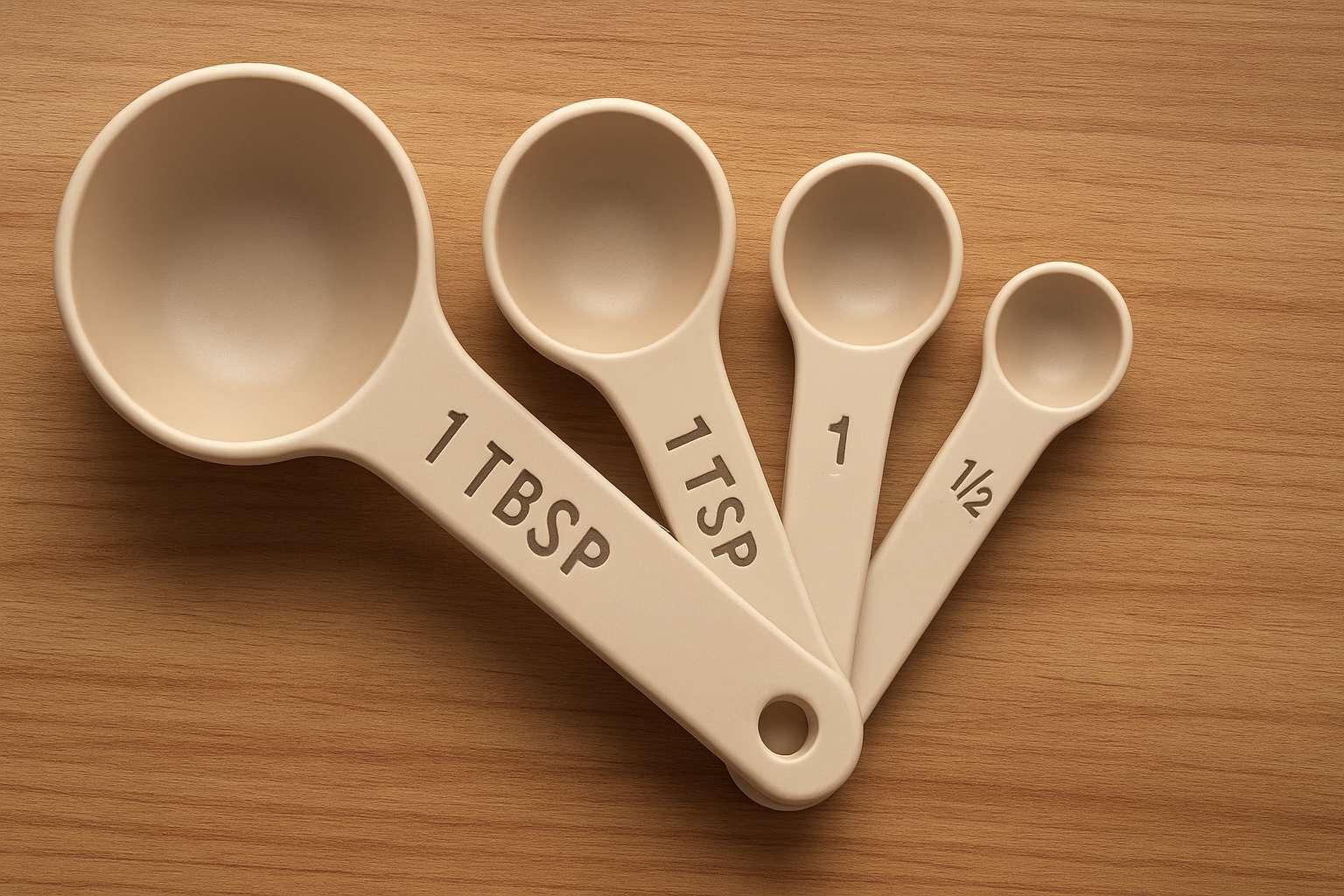
Household cutlery can vary significantly in size. What you think is a teaspoon might actually hold 4 mL (0.14 fl oz) or 7 mL (0.24 fl oz), depending on the design. Always use calibrated measuring spoons made for cooking.
2. Level Off Your Ingredients
When a recipe calls for a level tablespoon or teaspoon, fill the spoon and then scrape it flat with a knife or straight edge. “Heaping” or “rounded” spoons can easily double the intended amount.
3. Pay Attention to Recipe Language
Phrases like “scant tablespoon” or “rounded teaspoon” have specific meanings in culinary writing. “Scant” means slightly less than full; “rounded” means the ingredient mounds above the rim.
4. Consider a Metric Scale
For maximum precision, many professionals prefer weighing ingredients rather than using volume measures. This eliminates the variability caused by ingredient density (for example, a tablespoon of flour can weigh differently depending on how it’s packed).
5. Be Consistent
The most important rule: once you start measuring in one system, stick with it. Mixing tablespoons from one standard with teaspoons from another introduces inconsistency.
Frequently Asked Questions
Can I use regular spoons instead of measuring spoons?
Technically, you can—but results will vary. Everyday teaspoons and tablespoons are not standardized. A “teaspoon” from your cutlery drawer might hold anywhere from 4 mL (0.14 fl oz) to 7 mL (0.24 fl oz). That difference adds up, especially in baking or spice-heavy recipes. Measuring spoons are inexpensive and eliminate guesswork.
Why does my Australian recipe taste different when I use U.S. tablespoons?
Because the Australian tablespoon equals 20 mL (0.68 fl oz), while the U.S. tablespoon is roughly 15 mL (0.50 fl oz). If you follow an Australian recipe but measure using U.S. spoons, you’ll consistently add less than what the recipe intends—leading to drier batters or under-seasoned dishes.
How do I adjust a U.K. or Canadian recipe for American spoons?
Luckily, the U.K., Canada, and the U.S. all use a near-identical tablespoon-to-teaspoon ratio (3:1). You can generally use your U.S. measuring spoons without adjustment for recipes from these regions. Just be cautious with older British recipes, where the tablespoon size might differ.
Is there a universal standard?
Not yet. Even though the metric system is globally dominant, culinary practice remains rooted in tradition. Tablespoon and teaspoon measures still vary slightly by region, reflecting the culinary culture of each country.
What about dessertspoons and coffee spoons mentioned in old recipes?
These are remnants of pre-standardization days. A “dessertspoon” was historically between a teaspoon and a tablespoon, often around 10 mL (0.34 fl oz). Unless you’re recreating historical recipes, they’re largely obsolete today.
The Science Behind a Spoon
Beyond practicality, there’s a fascinating scientific underpinning to why small measurement errors matter. Many food reactions depend on ratios—for instance, the balance between leavening acid and base, or between fat and flour. A tablespoon that’s just 5 mL (0.17 fl oz) too large can disrupt those ratios, altering texture and flavor.
In baking, chemical reactions rely on precise proportions of wet to dry ingredients.
In sauces, emulsification depends on stable ratios of fat and liquid.
In candy-making, crystallization can be thrown off by minute variations.
That’s why professional kitchens rely on standard spoons and scales, not approximations. Even though home cooking allows for creativity, the foundation of good flavor often lies in disciplined accuracy.
Historical Perspective: From Tableware to Science
The modern tablespoon and teaspoon didn’t originate in laboratories but at the dining table. In the 18th and 19th centuries, households used “table” and “tea” spoons of varying capacities. It wasn’t until industrial production and international trade expanded that the need for uniformity became obvious.
19th century: Apothecaries and cooks began seeking standardized measurements.
20th century: Governments formalized metric and customary equivalents.
Today: Digital tools and global recipe sharing have made these conversions more important than ever.
This evolution from household utensil to standardized scientific measure is a reminder of how cooking bridges everyday life and exact science.
Practical Adaptation for Global Cooking
In the modern digital kitchen, recipes cross borders instantly. A baker in Chicago might follow an Australian cake recipe; a home cook in London might try an American marinade. Knowing your tablespoon-to-teaspoon conversion becomes not just practical, but empowering.
When you encounter an unfamiliar recipe, ask yourself:
Where was it written?
Does it use metric or customary measures?
How precise does the recipe need to be?
If precision is key (baking, custards, sauces), adjust your spoons accordingly—or better yet, convert to milliliters (mL) or fluid ounces (fl oz). For looser dishes (soups, stews), minor differences usually won’t matter.
Conclusion
The humble tablespoon and teaspoon might seem insignificant, but they carry centuries of culinary evolution, regional identity, and scientific precision. Whether you’re whisking a vinaigrette or measuring baking powder, those small scoops are the language of proportion—the grammar of good cooking.
Key takeaway:
Always check where your recipe originates, and use the corresponding measurement standard:
🇺🇸 U.S. & 🇨🇦 Canada — 1 tbsp = 3 tsp = 15 mL = 0.51 fl oz
🇦🇺 Australia — 1 tbsp = 4 tsp = 20 mL = 0.68 fl oz
🇬🇧 U.K. — 1 tbsp = 3 tsp = 15 mL = 0.51 fl oz
Keep a conversion chart handy, use standardized tools, and remember: cooking may be art, but measuring is science. When both are in harmony, your dishes will always reflect balance, precision, and flavor integrity.