Accurate ingredient measurement is essential in every kitchen, whether in Texas, Toronto, Melbourne, or London. Even small changes in flour, sugar, oil, or spices can affect texture, flavor, and overall results. Because recipes across English-speaking countries use cups, tablespoons, teaspoons, milliliters, and grams, cooks often need quick conversions. One of the most common is between tablespoons and cups. Fractional amounts like 1/4 cup appear frequently, especially in baking where precision matters. This leads to a key question: How many tablespoons are in 1/4 cup? The answer is simple, but understanding why—and how to use it—helps build confidence and consistency in the kitchen.
The Exact Answer
The direct conversion is:
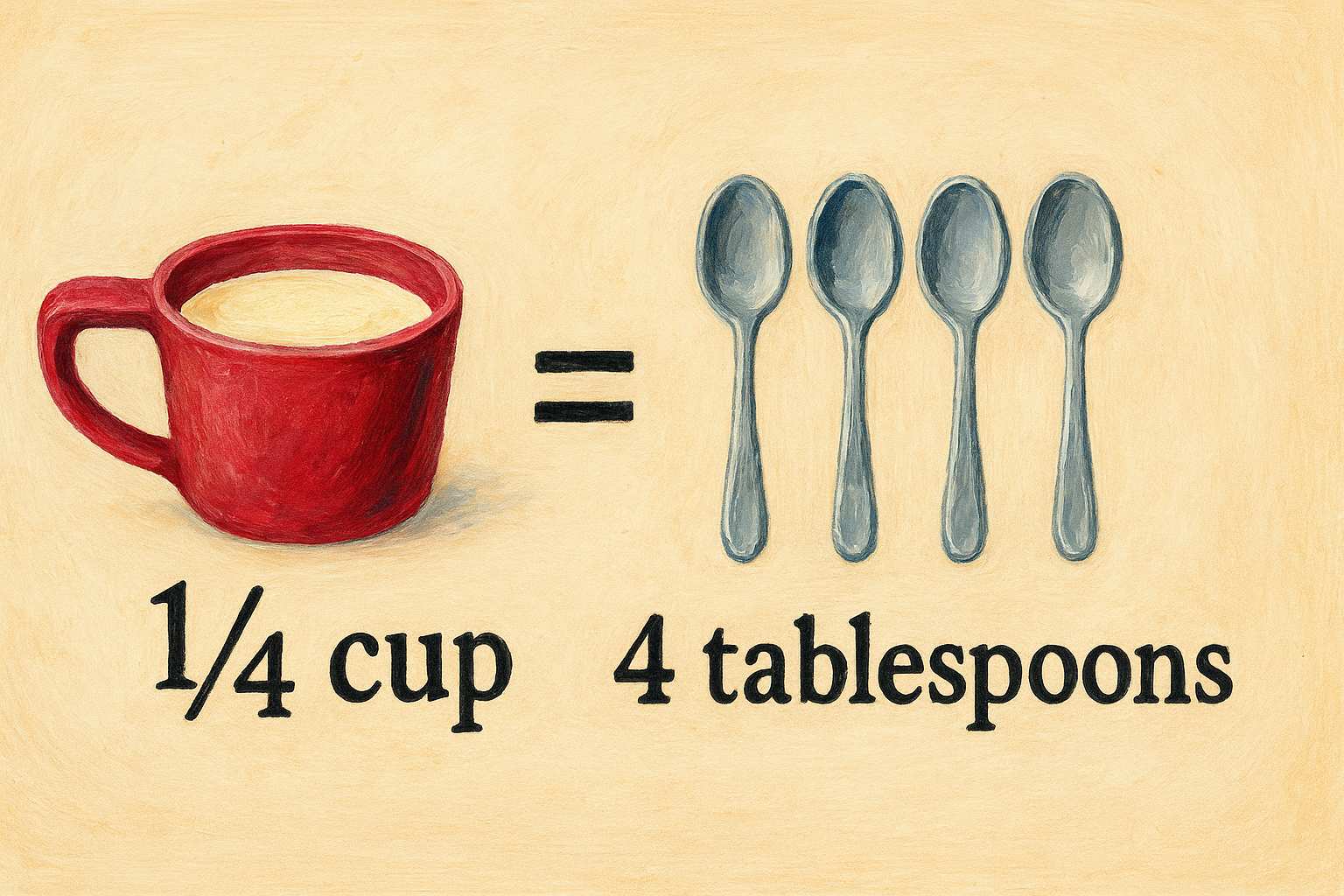
1/4 cup = 4 tablespoons
This equivalence comes from the U.S. customary measurement system, which is widely used in the United States and appears frequently in Canadian and Australian recipes as well. Even in the United Kingdom, where metric units dominate, cooks still encounter tablespoons and cups—especially in recipes originating from North America.
In the U.S. customary system, volume measurements such as cups, tablespoons, and teaspoons follow a consistent structure. Each unit divides evenly into the others, making it straightforward to translate between them once you understand the base relationships.
One cup contains 16 tablespoons. Because a quarter cup is one-fourth of a cup, dividing 16 by 4 gives the conversion for 1/4 cup. This simple relationship makes fraction-based conversions easy and is the reason many cookbook authors, teachers, and culinary professionals use it as a foundational example when explaining kitchen math.
How the Conversion Works
To break it down step-by-step:
1 cup = 16 tablespoons
This is the starting point. From here, the fractional conversions are derived by dividing accordingly.
To determine how many tablespoons are in 1/4 cup:
1/4 cup = 16 tablespoons ÷ 4 = 4 tablespoons
This formula is consistent across recipes that use U.S. customary measurements. Once you remember the baseline of 16 tablespoons per cup, all fractional conversions become easy mental math.
For example:
1/2 cup = 16 ÷ 2 = 8 tablespoons
1/3 cup = 16 ÷ 3 ≈ 5 tablespoons + 1 teaspoon
3/4 cup = 16 × 0.75 = 12 tablespoons
Understanding the underlying structure allows cooks to interpret recipes more confidently—especially when scaling them up or down.
Visual and Practical Examples
Even with clear numerical conversions, it can help to visualize what 4 tablespoons look like in real kitchen situations. Many cooks find it easier to picture measurements in terms of spoons or small piles of ingredients rather than fractions of a cup.
What 4 Tablespoons Look Like
Four tablespoons, when placed side by side, roughly fill the same space as one quarter cup in a measuring cup. If you’re working with liquid ingredients such as melted butter, water, or oil, 4 tablespoons will neatly fill a small puddle at the bottom of a standard mixing bowl. For dry ingredients like flour or sugar, 4 tablespoons make up a small mound that fits neatly in the palm of a hand.
When This Conversion Is Especially Useful
This conversion becomes particularly handy in several situations:
Baking:
Recipes often call for specific proportions of butter, flour, or sweeteners. If the recipe lists a quarter cup but you're measuring with spoons, knowing the tablespoon equivalent saves time and keeps proportions accurate.
Small-batch recipes:
People preparing meals for one or two servings often reduce larger recipes. When halving a recipe that calls for 1/2 cup of an ingredient, the new quantity becomes 1/4 cup—which is easily measured with 4 tablespoons.
Adjusting sauces or dressings:
Liquid ingredients like vinegar, lemon juice, or soy sauce are often measured in tablespoons for small quantities. Converting from a quarter cup helps achieve the exact flavor balance.
Doubling or tripling recipes:
If a recipe calls for 1/4 cup of an ingredient and you're multiplying the total output, measuring the new quantity in tablespoons can sometimes be easier than reaching for larger cups.
By connecting the numerical conversion with the physical experience of measuring, cooks develop a more intuitive sense of kitchen measurement.
Measurement Tips
Accuracy matters, especially in baking. The difference between a level tablespoon and a heaping one can significantly affect the outcome of a recipe. Understanding how to measure properly helps ensure that conversions like 1/4 cup to 4 tablespoons yield reliable results.
How to Measure Tablespoons Accurately
When measuring dry ingredients, fill the spoon and level it off with a straight edge such as the back of a knife. This creates a consistent, flat top and prevents accidental over-packing—particularly relevant for ingredients like flour, cocoa powder, or powdered sugar.
For liquid ingredients, fill the spoon until the surface reaches the rim. Avoid lifting the spoon too quickly or at an angle, since that may spill a portion and reduce accuracy.
Common Mistakes
Two of the most common errors include:
Heaping vs. level tablespoons: A heaping spoonful may contain significantly more than a level spoonful, depending on the ingredient.
Packing ingredients unintentionally: Pressing ingredients like brown sugar or flour too firmly into the spoon increases density and volume.
Being consistent in how you fill and level each tablespoon leads to more predictable results.
Dry vs. Liquid Measuring Cups
Dry and liquid cups serve the same purpose—measuring volume—but they are shaped differently to improve accuracy. Dry cups are designed for scooping and leveling, while liquid cups allow users to pour and check the fill line at eye level. Using the appropriate type helps minimize measurement inconsistencies.
While tablespoons work for both liquid and dry ingredients, measuring larger amounts with the correct type of cup ensures the best precision.
Comparison With Other Measurements
Understanding how 1/4 cup translates into various units makes it easier to adapt recipes from different regions or formats. Below are common equivalents widely used in English-speaking countries.
1/4 Cup in Teaspoons
Since 1 tablespoon equals 3 teaspoons:
4 tablespoons × 3 teaspoons = 12 teaspoons
So:
1/4 cup = 12 teaspoons
1/4 Cup in Milliliters
The milliliter equivalent varies slightly based on region, but the widely accepted conversion is:
1/4 cup ≈ 60 milliliters
This number is a convenient reference when working with metric-based recipes or tools.
Quick Tablespoon ↔ Cup Reference
1 tablespoon = 1/16 cup
2 tablespoons = 1/8 cup
4 tablespoons = 1/4 cup
8 tablespoons = 1/2 cup
12 tablespoons = 3/4 cup
16 tablespoons = 1 cup
These conversions serve as a flexible guide whenever you need to switch between cups and spoons.
FAQ Section
Is 1 Tablespoon the Same in All Countries?
Tablespoon sizes are consistent in many places, but not all. The U.S. tablespoon is standardized at approximately 14.8 milliliters. In contrast, the Australian tablespoon is slightly larger at 20 milliliters. The U.K. traditionally used a 15-milliliter tablespoon, though modern measuring sets often follow the metric standard.
Because of these subtle differences, cooks working with international recipes sometimes adjust measurements mentally or rely on metric conversions for complete accuracy.
Region | Tablespoons in 1/4 Cup | Notes |
|---|---|---|
United States | 4 tablespoons | Based on the U.S. tablespoon (≈14.8 ml) and U.S. cup (≈240 ml) |
Australia | 4 tablespoons | Uses a larger tablespoon (20 ml), but the cup-to-tablespoon structure still results in 4 tbsp per 1/4 cup |
United Kingdom | 4 tablespoons (modern sets) | Most modern U.K. measuring tools follow the metric standard (15 ml tablespoon). Older cookbooks may vary but still align with 4 tbsp per 1/4 cup |
Can You Substitute Tablespoons for Teaspoons or Grams?
Tablespoons and teaspoons convert cleanly because they are both units of volume. Grams, however, measure weight. The weight of one tablespoon of an ingredient depends on its density. For example, one tablespoon of honey weighs more than one tablespoon of flour. Because of this, tablespoons cannot always be substituted directly for grams without a reference chart specific to each ingredient.
Are There Differences Between U.S. and U.K. Cup Sizes?
While cups are used less frequently in the United Kingdom, some older or imported cookbooks may include them. The U.S. cup is approximately 240 milliliters. The U.K. historically used a slightly larger imperial cup, though it is rarely used today. Modern British recipes generally rely on grams and milliliters rather than cups. When in doubt, using the metric equivalents ensures consistency.
Conclusion
The essential fact is clear and straightforward:
1/4 cup = 4 tablespoons
Since 1 cup holds 16 tablespoons, converting any cup fraction becomes easy. Knowing these basic conversions improves accuracy, simplifies recipe prep, and helps when using recipes from different countries. Understanding how tablespoons relate to cups builds confidence and consistency in everyday cooking.