
Unit conversions may seem minor, but they shape everyday decisions more than many people realize. From estimating travel time to reading maps or planning workouts, switching between units helps people navigate information clearly. In countries like the United States and the United Kingdom, traditional units such as miles, feet, and yards exist alongside metric measurements, making conversions a common necessity.
One conversion appears frequently: miles to feet. Miles show up on road signs and in conversations, while feet describe smaller distances like height or room size. Many learn the conversion in school but later forget the exact number.
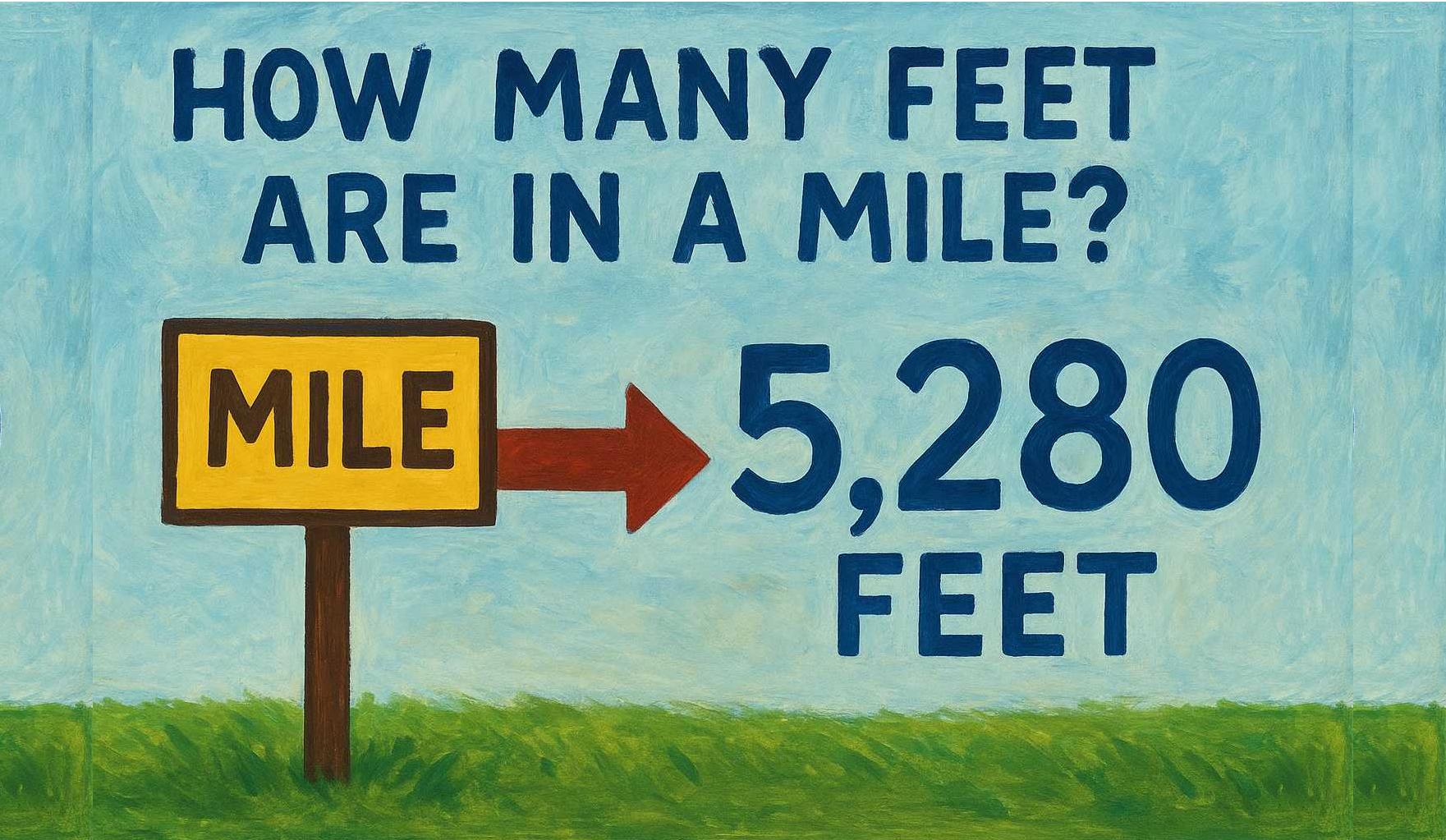
This raises a simple but important question: How many feet are in a mile? The answer is precise and historically grounded, offering insight into practical measurement use and the cultural roots behind today’s units.
The Exact Answer
The exact number of feet in a mile is:
1 mile = 5,280 feet
This figure is not an approximation. It is a fixed and standardized measurement used throughout the modern world wherever the statute mile is recognized.
But where does this very specific number come from—especially when it seems so unusually exact yet not particularly “round” by modern standards? To understand that, we must explore the mile’s history.
Historical Background
The mile’s story stretches back thousands of years, beginning long before standardized measurement systems existed. Its origins are rooted in ancient civilizations, adapted over time, and shaped by practical needs such as land surveying, agriculture, taxation, military movement, and navigation.
Origins of the Mile
The term “mile” traces back to the Latin phrase mille passus, meaning “a thousand paces.” In the Roman system, a single pace was measured as two steps—left foot then right foot—covering roughly five Roman feet. Therefore, a thousand paces equaled about 5,000 Roman feet.
This early version of the mile became a widely used measurement across territories influenced by Roman culture. However, as centuries passed and various regions adapted traditional measurements to their own needs, many versions of a “mile” emerged with different lengths depending on local customs and practical considerations.
How the Modern Definition Was Standardized
The modern mile used in the United States, the United Kingdom, and several other regions is known as the statute mile. Its standardized length—5,280 feet—originated from a reform in England during the late 16th century.
Before this reform, the mile was often defined as 5,000 feet, closely following the Roman tradition. However, English land measurement systems also relied heavily on the furlong, a unit historically associated with plowing fields. A furlong was standardized at 660 feet, and there were 8 furlongs in a mile. Multiplying 660 by 8 results in 5,280 feet.
Why 5,280 Feet Instead of a Rounder Number?
The choice of 5,280 feet was not made for mathematical convenience but for practical agricultural and land management reasons. By aligning the mile with the established furlong, surveyors and landowners could maintain consistency in property boundaries, crop field sizes, and road layout. The furlong, in turn, related to other traditional units such as chains, perches, and rods. In essence, the statute mile was designed to mesh seamlessly with existing land-based measurements rather than replace them.
This historical decision, based on the needs of its time, remains the standard today—even though modern measurement systems have evolved significantly.
Conversion Formula
Knowing that one mile equals 5,280 feet gives you a straightforward formula for converting between these units.
Basic Conversion from Miles to Feet
To convert miles into feet:
feet = miles × 5,280
This formula allows you to scale up easily depending on how many miles you’re dealing with.
Reverse Conversion from Feet to Miles
To convert feet into miles, simply reverse the process:
miles = feet ÷ 5,280
Examples of Simple Calculations
These examples demonstrate how the formulas work in everyday situations:
Example 1:
If a trail is 2 miles long, its length in feet is:
2 × 5,280 = 10,560 feetExample 2:
If you walked 13,200 feet, the distance in miles is:
13,200 ÷ 5,280 = 2.5 milesExample 3:
For a half-mile distance:
0.5 × 5,280 = 2,640 feet
Once you remember that single key number—5,280—the rest falls neatly into place.
Comparison with Other Units
The mile is part of a broader family of traditional length units commonly used in American and British contexts. Understanding how it relates to nearby units helps make the conversion more intuitive.
How the Mile Relates to Yards
There are 3 feet in a yard, which gives:
1 mile = 1,760 yards
This relationship is especially useful in sports, certain engineering fields, and older surveying practices.
How the Mile Relates to Meters
The mile does not fit neatly into the metric system, but its conversion is well-established:
1 mile ≈ 1,609.344 meters
This means that the mile is a little longer than 1.6 kilometers.
How the Mile Relates to Kilometers
Using the meter conversion:
1 mile ≈ 1.609 kilometers
1 kilometer ≈ 0.621 miles
This comparison helps bridge traditional and metric systems, especially when interpreting international data or scientific information.
Real-World Examples
Understanding the conceptual measurement of a mile is helpful, but seeing how it appears in daily life can make the conversion feel more grounded. Here are several contexts where knowing feet-to-mile relationships becomes practical.
Distance of a Running Track
A standard outdoor running track is typically 400 meters per lap. If you want to approximate its length in feet and miles:
400 meters is about 1,312 feet.
Four laps, making up roughly one mile, total about 5,248 feet—which is very close to the standard 5,280-foot mile.
This small difference matters in competitive timing but is negligible for general fitness purposes.
Length of City Blocks
City block lengths vary significantly depending on urban planning styles. However, some regions—especially older cities—use block lengths that can be related to feet or miles in useful ways. For example, if a block is around 300 to 600 feet long, you would need roughly 9 to 18 blocks to cover a mile. These estimates aren’t universal but illustrate how urban environments intersect with unit measurements.
Driving Distances and Road Signs
Road signs in countries using miles help drivers gauge how long it will take to reach an exit or intersection. If someone knows that one mile equals 5,280 feet, they can mentally convert shorter distances—like a sign indicating a turn in 0.25 miles—into a more tangible figure:
0.25 miles = 1,320 feet
This can help in situations where visual judgment of physical distance is easier than interpreting decimal values.
Practical Scenarios Where Conversions Help
The ability to convert between miles and feet proves practical in situations such as:
Estimating walking routes during outdoor activities
Measuring rural or suburban land parcels
Interpreting map scales
Planning construction or surveying tasks
Understanding elevation gain on trails
Interpreting athletic performance data
Each of these tasks benefits from an intuitive sense of how long a mile is in feet.
Common Confusions and Misconceptions
Because the word “mile” appears in several contexts, it is important to distinguish between similar but different units. Three types of miles are frequently referenced: the statute mile, the nautical mile, and the metric mile.
Statute Mile
The statute mile is the standard mile of 5,280 feet used on land for everyday purposes in the United States and the United Kingdom. Whenever someone refers simply to a “mile,” this is usually what they mean.
Nautical Mile
A nautical mile is used in navigation—both maritime and aviation. It is based on the geometry of the Earth rather than a traditional land measurement. One nautical mile equals:
1 nautical mile ≈ 6,076 feet
1 nautical mile = 1,852 meters
Because it reflects degrees of latitude, it provides a consistent measurement for plotting courses across the globe.
Metric Mile
Despite its name, the metric mile is not an official metric unit. Instead, it is a term sometimes used in sports, referring to a distance of 1,500 meters, which is slightly shorter than a statute mile. It appears in track and field events as a close metric equivalent.
Understanding these distinctions helps prevent confusion, especially when reading scientific data, interpreting aviation or marine information, or following international athletic discussions.
Quick Reference Table
Below is a simplified reference chart summarizing key conversions:
Unit | Equivalent |
|---|---|
1 mile | 5,280 feet |
1 mile | 1,760 yards |
1 mile | 1,609.344 meters |
1 mile | 1.609 kilometers |
1 foot | 0.00018939 miles |
1 yard | 3 feet |
1 kilometer | 0.621 miles |
This table provides a convenient way to visualize the relationships among these commonly used units.
Conclusion
The key fact is straightforward: one mile equals 5,280 feet. This number comes from historical practices in land measurement and surveying. Even with modern digital tools, knowing how these units relate is still useful for estimating distances, reading maps, or understanding data.
Unit conversions link different measurement systems and help clarify scale and context. The mile-to-feet relationship is a simple example of how a single value can reveal the structure behind a larger system. Exploring other units and their origins can further deepen understanding of how people measure and interpret the world around them.