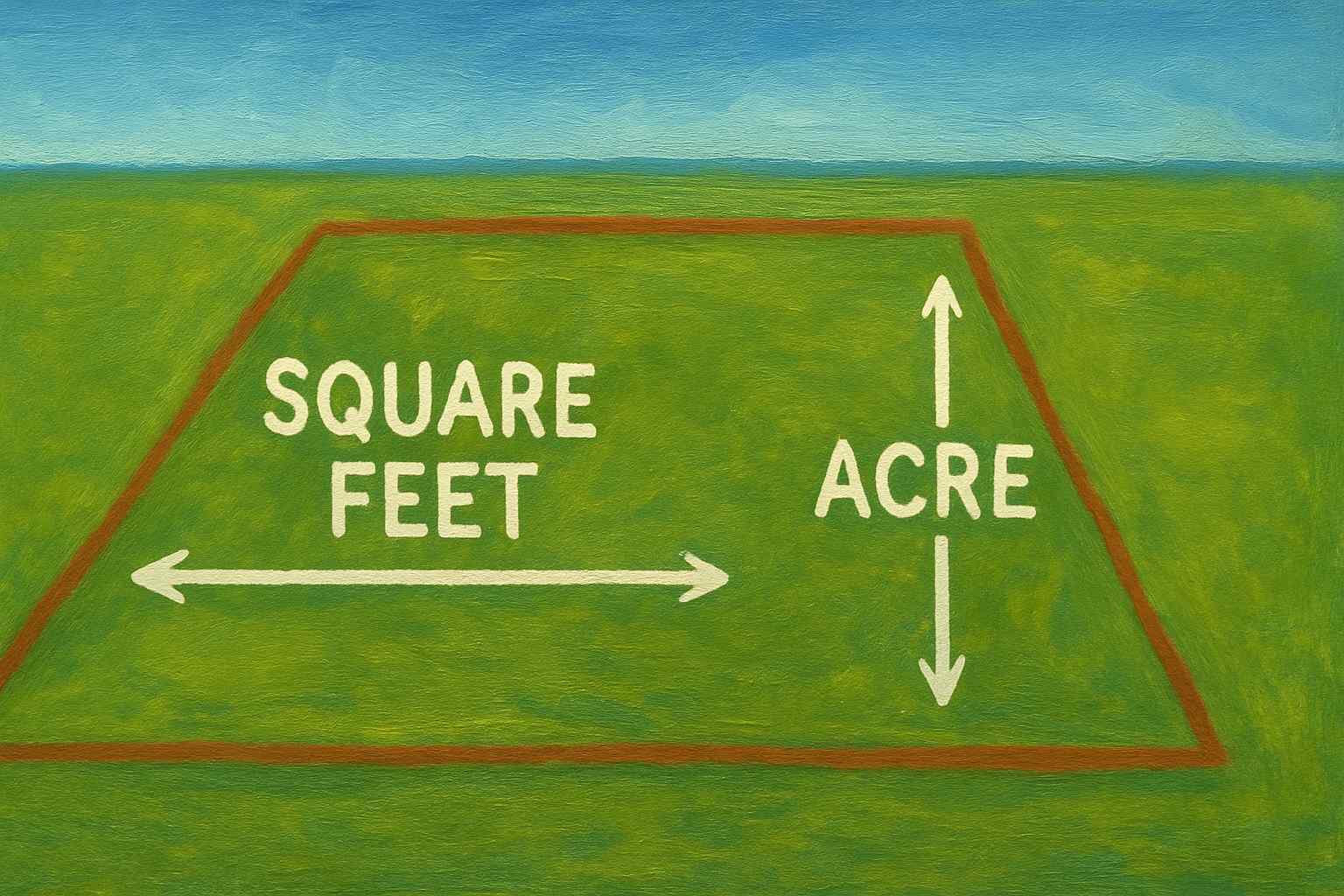
Land measurement is important in daily life, especially in regions using both traditional and metric systems. Whether reviewing a residential lot, planning construction, or comparing farmland, understanding land units supports informed decisions. The acre is a widely recognized unit in the United States, commonly referenced in Canada and the United Kingdom, and historically noted in Australia.
A frequent question in real estate and land development is: How many square feet are in an acre? The answer is exact, but understanding it fully involves knowing what an acre represents and how it originated.
This article offers a concise explanation of the acre, its conversion to square feet, and its role in practical, everyday contexts.
What Is an Acre?
The acre is a traditional unit of land area used primarily in countries that have historical ties to the imperial measurement system. While the metric system has become the global standard, the acre has retained its importance in various applications, especially in the United States and, to a lesser extent, in Canada and the United Kingdom.
Definition of an Acre
An acre is formally defined as an area of land containing 43,560 square feet. Unlike square units that form a perfect geometric square, an acre does not specify a particular shape. Any plot with a total area of 43,560 square feet qualifies as an acre, whether it is square, rectangular, irregular, or divided into several connected parts.
Historical Origins
The acre’s origin stretches back to medieval agriculture. Its earliest definition described the amount of land that a pair of oxen could plow in a single day. Because this depended on local agricultural practices and soil conditions, the size of an acre varied significantly across regions.
As commerce and taxation systems became more organized, the acre underwent a process of standardization. Eventually, it was legally defined as a fixed measurement. The commonly accepted definition today—43,560 square feet—emerged from the traditional British land measurement system, which used “chains” and “furlongs.” One acre was equal to:
1 chain (66 feet) × 1 furlong (660 feet)
10 square chains
160 square rods
Although these units are rarely used today, they illustrate how the acre was tied to older surveying practices.
Use in Modern Countries
United States: The acre is the primary unit for land measurement in real estate, agriculture, and land development.
United Kingdom: The acre is still recognized and commonly used informally, although the metric system is officially adopted.
Canada: The acre appears in some agricultural and rural contexts, though hectares and square meters are also used.
Australia: The acre is mostly historical but still referenced in rural or traditional contexts.
Despite increasing use of metric units worldwide, the acre remains deeply embedded in land-related language and practice.
Converting Acres to Square Feet
The relationship between acres and square feet is precise and officially defined.
Exact Conversion
1 acre = 43,560 square feet
This is a fixed and exact value, not an approximation. The number arises from the historical definition of the acre based on chains and furlongs:
1 acre = (66 ft × 660 ft)
66 × 660 = 43,560 square feet
Although these older units are no longer part of most modern measurement systems, the derived value remains the standard.
Why 43,560?
The number may seem unusual compared to rounded metric units, but it follows from older surveying conventions. Surveyors preferred units divisible into smaller fractions that could be used in land transactions and taxation. As a result, the acre has many convenient divisors—ideal for dividing land into halves, quarters, eighths, and so on.
Rounded Values for Mental Calculation
For quick estimation:
1 acre ≈ 44,000 sq ft (simple rounding)
1 acre ≈ 43,500 sq ft (closer to the exact value)
These approximations are useful for mental math when high precision is not required.
Practical Examples
Understanding the size of an acre in square feet becomes easier when connected to real-world examples. While the acre may sound abstract, its applications are found everywhere—from neighborhoods to sports facilities to farmland.
Residential Lot Sizes
In the United States, residential lot sizes vary dramatically, but many suburban lots range from one-tenth of an acre to half an acre. This means:
0.1 acre = 4,356 sq ft
0.25 acre = 10,890 sq ft
0.5 acre = 21,780 sq ft
These measurements help illustrate how much land is available for a house, yard, driveway, and landscaping.
Agricultural Fields and Farmland
Farmland is commonly measured in acres. A single acre might support a small garden or orchard, while large agricultural operations may cover hundreds or thousands of acres. Knowing the square footage helps farmers estimate:
planting density
irrigation needs
crop spacing
equipment requirements
Recreational Areas
Parks, sports fields, and outdoor recreational areas are often described using acres. For example:
A standard American football field (including end zones) covers about 57,600 square feet, which is approximately 1.32 acres.
A soccer field varies in size but often falls between 1.5 and 2 acres.
These comparisons help visualize the scale of an acre in a familiar context.
Visualizing an Acre
Because the acre does not require a specific shape, comparisons are especially helpful:
A square acre would measure about 208.7 feet per side.
A rectangular acre could measure 100 feet × 435.6 feet.
These dimensions help illustrate how flexible the acre is as a unit of measurement.
Other Useful Conversions
Although the focus of this article is acres and square feet, land measurement often involves switching between several related units. Understanding these relationships provides a clearer overall picture.
Acres to Square Meters
Square meters are part of the metric system and widely used globally.
1 acre = 4,046.856 square meters
This exact value is based on the metric definition of the foot and its relationship to the meter.
Acres to Hectares
The hectare is a metric unit commonly used for larger land areas, especially in agriculture.
1 hectare = 10,000 square meters
1 acre = 0.404686 hectare
1 hectare ≈ 2.471 acres
These conversions are helpful in countries where both imperial and metric units appear in land documents.
Square Feet to Acres
For smaller areas measured in square feet:
1 square foot = 0.0000229568 acres
10,000 sq ft ≈ 0.23 acres
20,000 sq ft ≈ 0.46 acres
This is common when evaluating building footprints, parking areas, or subdivisions.
Tips for Quick Estimation
Without a calculator, approximate methods can be useful:
Round 43,560 up to 44,000 for mental division.
Treat 1 acre ≈ 4,000 square meters (a rough rounded metric equivalent).
Visualize an acre as slightly larger than a football field minus the end zones.
These techniques provide fast, reasonably close estimates for everyday situations.
Tools for Fast Conversion
Modern devices allow quick and accurate conversions. Most phones and computers include built-in conversion tools. Search engines also solve unit conversions instantly. While manual calculation helps deepen understanding, digital tools provide speed and precision when interpreting land listings, planning projects, or comparing measurements across systems.
Acres | Square Feet |
|---|---|
0.1 acre | 4,356 sq ft |
0.2 acre | 8,712 sq ft |
0.25 acre | 10,890 sq ft |
0.3 acre | 13,068 sq ft |
0.4 acre | 17,424 sq ft |
0.5 acre | 21,780 sq ft |
0.6 acre | 26,136 sq ft |
0.75 acre | 32,670 sq ft |
1 acre | 43,560 sq ft |
1.5 acres | 65,340 sq ft |
2 acres | 87,120 sq ft |
3 acres | 130,680 sq ft |
4 acres | 174,240 sq ft |
5 acres | 217,800 sq ft |
6 acres | 261,360 sq ft |
7 acres | 304,920 sq ft |
8 acres | 348,480 sq ft |
9 acres | 392,040 sq ft |
10 acres | 435,600 sq ft |
20 acres | 871,200 sq ft |
Conclusion
Understanding how many square feet are in an acre is essential for interpreting land measurements in real estate, construction, agriculture, and outdoor planning. The key fact is straightforward and exact:
1 acre = 43,560 square feet
This long-established unit continues to shape conversations about land size across multiple English-speaking countries. Whether examining a residential lot, estimating a sports field, or assessing rural property, knowing the relationship between acres and square feet provides clarity and accuracy.
By keeping this conversion in mind and using available tables or digital tools when needed, anyone can confidently navigate land measurements and better understand the scale of the spaces around them.