
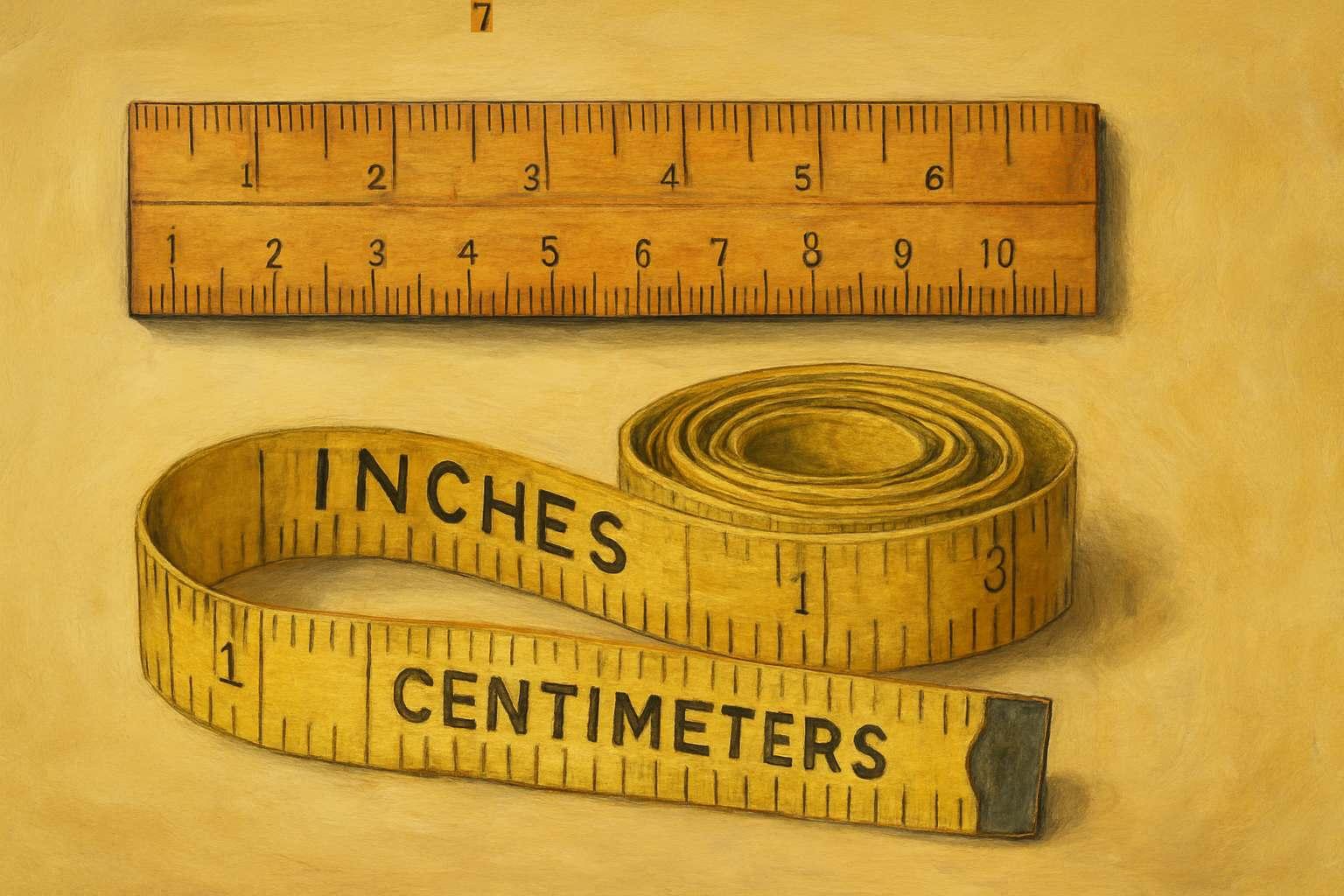
Understanding how to convert between inches and centimeters is more than a simple mathematical exercise — it’s a skill that bridges two worlds of measurement. Across fashion, construction, technology, and even healthcare, both metric and imperial systems play key roles. In everyday life, we often encounter one system or the other depending on where we live, where a product was made, or who we are communicating with.
For example, a clothing size chart may list measurements in centimeters, while a U.S. hardware manual might specify dimensions in inches. A person reading an international health report might see height expressed in centimeters, whereas American sports statistics often use feet and inches. Even when purchasing televisions, monitors, or furniture, knowing how to translate between these units helps make sense of specifications.
So, how many inches are in a centimeter, and why does this matter? To answer that, we need to understand what these units represent, where they come from, and how to convert between them with accuracy and confidence.
1 inch = 2.54 centimeters
What Is an Inch?
An inch is a unit of length in the Imperial and U.S. customary systems of measurement. It’s widely used in the United States, the United Kingdom, and a few other countries that still rely on these traditional systems for everyday applications.
Definition
Technically, one inch is defined as exactly 2.54 centimeters. This modern definition was internationally agreed upon in 1959 to standardize measurements across scientific, industrial, and commercial fields.
Historical Background
The inch has a long and somewhat inconsistent history. In medieval Europe, the inch was not standardized and could vary by region. It often originated from body-based references — for instance, the width of a thumb. Over centuries, as trade and manufacturing demanded greater precision, standard definitions emerged.
By the 19th and 20th centuries, industrial nations formalized the inch as part of a consistent measurement system. The 1959 agreement — often called the “International Yard and Pound Agreement” — officially fixed one inch at 2.54 centimeters, aligning the Imperial and metric standards once and for all.
Where It’s Used
Today, the inch remains deeply embedded in daily life in:
The United States, where most construction, real estate, and product dimensions rely on inches and feet.
The United Kingdom, especially for height measurements, screens, and some engineering contexts.
Canada and Australia, where both metric and imperial units coexist, with the metric system officially dominant but imperial terms still common in casual speech (for instance, describing a person’s height or a screen size).
What Is a Centimeter?
A centimeter (cm) is a unit of length in the metric system, which is officially part of the International System of Units (SI).
Definition
One centimeter equals one-hundredth of a meter. The metric system was designed to be simple, decimal-based, and universally applicable, making conversions straightforward.
Metric System Origins
The metric system originated in France during the late 18th century, at a time when European nations were using many inconsistent local units. Its creation was motivated by the need for clarity and standardization across science, trade, and education.
Unlike the inch, which arose from approximate human references, the centimeter stems from a scientifically defined base unit: the meter, which is now defined by the distance light travels in a vacuum during a specific time interval.
Where It’s Used
The centimeter dominates in:
Most of Europe, especially in manufacturing, science, medicine, and education.
Asia and South America, where metric units are universally taught and used in daily life.
Global scientific research, since SI units are the international standard for all precise measurement.
Thus, while inches remain culturally familiar in certain English-speaking regions, centimeters are the global default in scientific and international contexts.
Conversion Formula
Now to the essential relationship:
1 inch = 2.54 centimeters
This definition is exact — there’s no rounding involved. Every inch equals exactly 2.54 cm.
Conversely, to go from centimeters to inches, you invert the formula:
1 centimeter = 0.3937 inches
Manual Conversion Examples
Let’s say you have a measurement of 10 inches and want to convert it to centimeters:
10 inches×2.54 = 25.4 cm
If you’re converting in the other direction — for instance, 50 centimeters to inches — you divide by 2.54:
50 cm ÷ 2.54 = 19.685 inches
Rounded to one decimal place, that’s approximately 19.7 inches.
These relationships are linear, meaning the same ratio applies no matter the scale — from microscopic dimensions to furniture sizes.
Conversion Table
Below is a short table showing some of the most common inch-to-centimeter conversions for quick reference:
Inches | Centimeters |
|---|---|
1 | 2.54 |
2 | 5.08 |
3 | 7.62 |
4 | 10.16 |
5 | 12.70 |
6 | 15.24 |
7 | 17.78 |
8 | 20.32 |
9 | 22.86 |
10 | 25.40 |
12 | 30.48 |
15 | 38.10 |
20 | 50.80 |
To calculate values beyond this, you can simply multiply or divide using the 2.54 factor.
Mental Shortcuts
While 2.54 is precise, many people round it to 2.5 for quick estimates. For example, 6 inches × 2.5 = 15 cm, which is slightly less than the true 15.24 cm — a difference small enough for casual use.
Similarly, to estimate inches from centimeters, remember that 1 cm ≈ 0.4 inches. This approximation allows fast, in-head calculations when precision isn’t crucial.
Online Converters and Calculators
In today’s digital environment, you don’t need to memorize formulas or tables to perform conversions. Nearly every smartphone, computer, or search engine can instantly convert between inches and centimeters.
For example, entering a phrase like “10 inches in cm” or “30 cm in inches” in a search bar will immediately display the answer. Many general-purpose unit converter tools and apps can handle such conversions for longer lists or mixed units (like feet and inches).
Built-in calculator apps on most devices also support conversion functions or can handle direct arithmetic with the 2.54 multiplier. For professionals, specialized design and engineering software typically includes automatic unit translation between metric and imperial systems.
These modern tools ensure accuracy while saving time — but understanding the math behind them helps interpret the results correctly.
Real-World Examples
The inch-centimeter relationship appears everywhere in daily life. Here are some of the most common situations where knowing the conversion helps bridge regional and professional differences.
1. Human Height
In the United States and United Kingdom, height is typically expressed in feet and inches. For example, someone who is 5 feet 9 inches tall can be converted to centimeters by first converting to total inches (5 × 12 + 9 = 69 inches) and then multiplying by 2.54:
69 × 2.54 = 175.26 cm
So, a person 5'9" tall is about 175 centimeters.
2. Electronics and Displays
Screen sizes for televisions, monitors, and laptops are measured diagonally in inches worldwide. A 15.6-inch laptop display equals:
15.6 × 2.54 = 39.624 cm
or roughly 39.6 centimeters.
Meanwhile, some manufacturers list dimensions in centimeters, especially in Europe or Asia. Knowing how to convert between them makes product comparisons easier.
3. Construction and Home Improvement
Carpenters and architects often use inches and feet in the U.S. and Canada, while metric units dominate in Europe and Australia. When dealing with imported materials, such as tiles, tools, or hardware, understanding both scales is crucial. For instance, a 2×4 board nominally refers to inches, while a 50 mm pipe measurement belongs to the metric side.
4. Clothing and Fashion
Sizing in fashion frequently crosses unit systems. A waist measurement of 32 inches corresponds to 81.28 centimeters — helpful when comparing international size charts. Footwear, belts, and accessories may also switch between systems depending on origin and target market.
5. Sports Equipment
Sports gear, such as bicycles, golf clubs, or snowboards, may list sizes in either centimeters or inches. A snowboard marked 160 cm long would be about 63 inches, while a 10-inch tablet would measure 25.4 cm diagonally.
6. Education and Science
Students studying international sciences, engineering, or medicine often must convert between metric and imperial systems. Understanding this relationship ensures clarity when interpreting laboratory data, medical reports, or global publications.
Tips and Memory Tricks
Remembering that 1 inch equals 2.54 centimeters can seem simple, but people often forget the decimal. Here are a few ways to lock it in your memory.
1. Association Method
The number 2.54 can be broken into a pattern: “2, 5, 4” — an easy ascending sequence. Thinking of it as “two-five-four” instead of a decimal can help it stick.
2. Rounded Shortcut
For quick approximations, use 2.5 as a stand-in for 2.54. The 0.04 difference adds only about 1.6% error, which is negligible in most casual uses.
Example: 40 inches × 2.5 = 100 cm (the true value is 101.6 cm).
3. Reverse Shortcut
To estimate inches from centimeters, divide by 2.5 instead of 2.54. This gives a slightly larger value, which compensates for rounding in many cases.
For instance, 100 cm ÷ 2.5 = 40 inches (true value 39.37 inches).
4. Visual Cues
A standard U.S. dollar bill is about 6.14 inches long, or roughly 15.6 cm. Remembering such everyday objects can help visualize the scale difference between inches and centimeters.
5. Pattern Recognition
Because 2.54 is exact, conversions between even numbers often yield memorable results:
10 inches = 25.4 cm
20 inches = 50.8 cm
30 inches = 76.2 cm
These repeating patterns make estimation faster once you’ve done a few conversions.
Conclusion
Inches and centimeters represent two distinct but interconnected worlds of measurement — the imperial and the metric systems. The inch, rooted in centuries of traditional use across English-speaking nations, remains a cultural and practical mainstay in everyday American and British life. The centimeter, part of the global metric framework, reflects a scientific and international approach to precision.
Knowing how to convert between them is essential not just for students and professionals but for anyone navigating a globalized world where products, information, and standards cross borders daily. Whether you’re comparing furniture dimensions, interpreting international size charts, or discussing your height with someone from another country, understanding this conversion enhances clarity and communication.
At its core, the conversion is elegantly simple:
1 inch = 2.54 centimeters
This single ratio unites two systems that, despite their differences, share a common goal — to measure the world accurately. And while digital tools make conversions effortless today, grasping their historical and mathematical foundation deepens our appreciation for the systems we rely on every day.