Understanding the relationship between quarts and gallons is essential for anyone dealing with liquid measurements - whether in cooking, chemistry, or engineering. These units belong to both the U.S. customary and the U.K. imperial systems, and although they share names, their actual values differ. This article explores what these units represent, how to convert between them, and where such conversions are practically used.
 Understanding the Quart and Gallon
Both the quart and the gallon are units of volume, typically used for liquids such as water, milk, fuel, or oil. They have long historical roots, originating from medieval English trade measurements. Over time, regional adaptations created the modern U.S. customary and Imperial (U.K.) systems.
In the U.S. customary system:
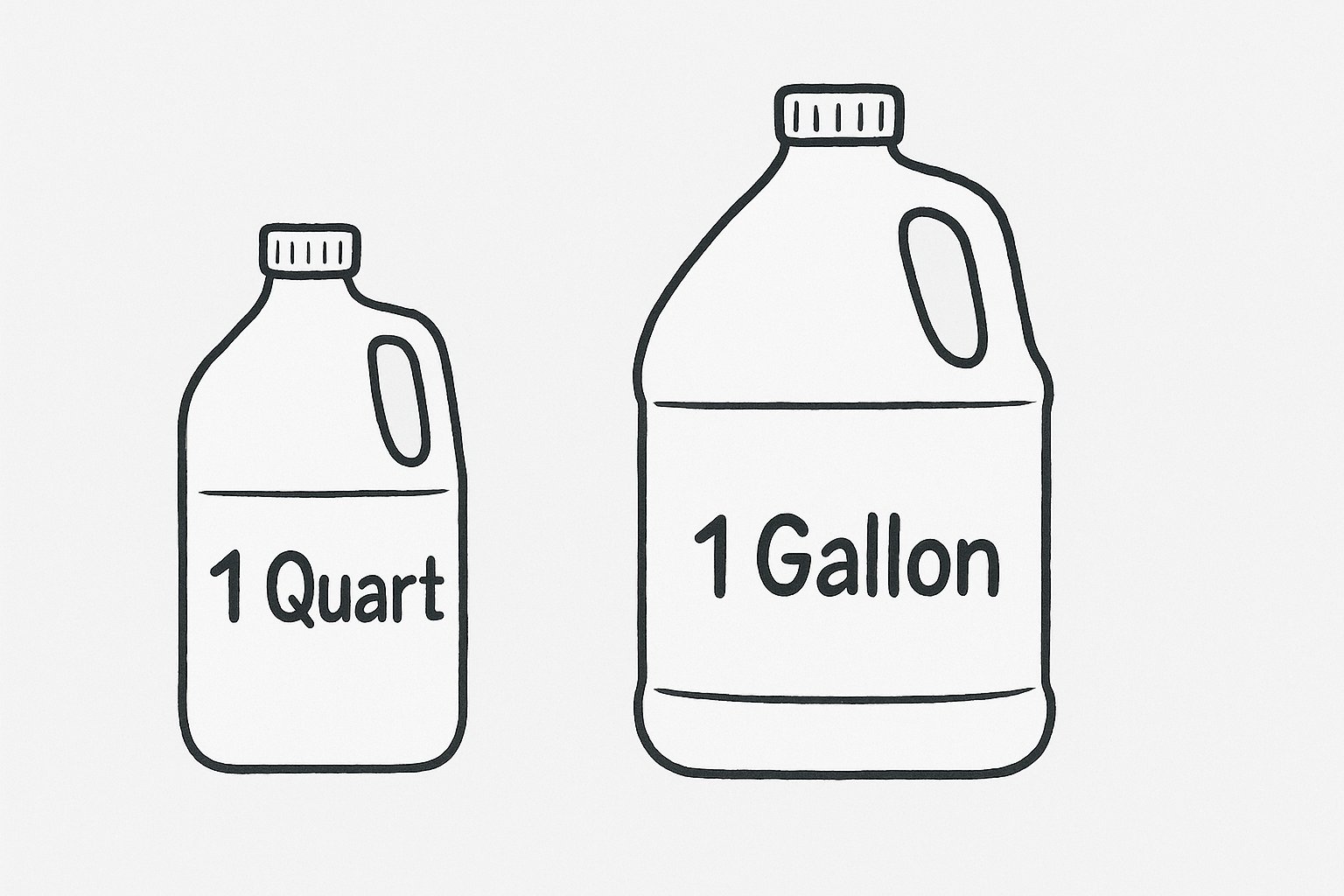
1 gallon (US) = 4 quarts (US)
1 quart (US) = 0.25 gallon (US)
This means that converting between these units involves dividing or multiplying by four, depending on the direction of the conversion.
Historically, several “gallon” standards existed for different substances like wine or ale. When measurement systems were standardized, the U.S. retained an older definition, while the U.K. later redefined its gallon based on water weight, creating the difference that persists today.
Qt to Gal Conversion Table
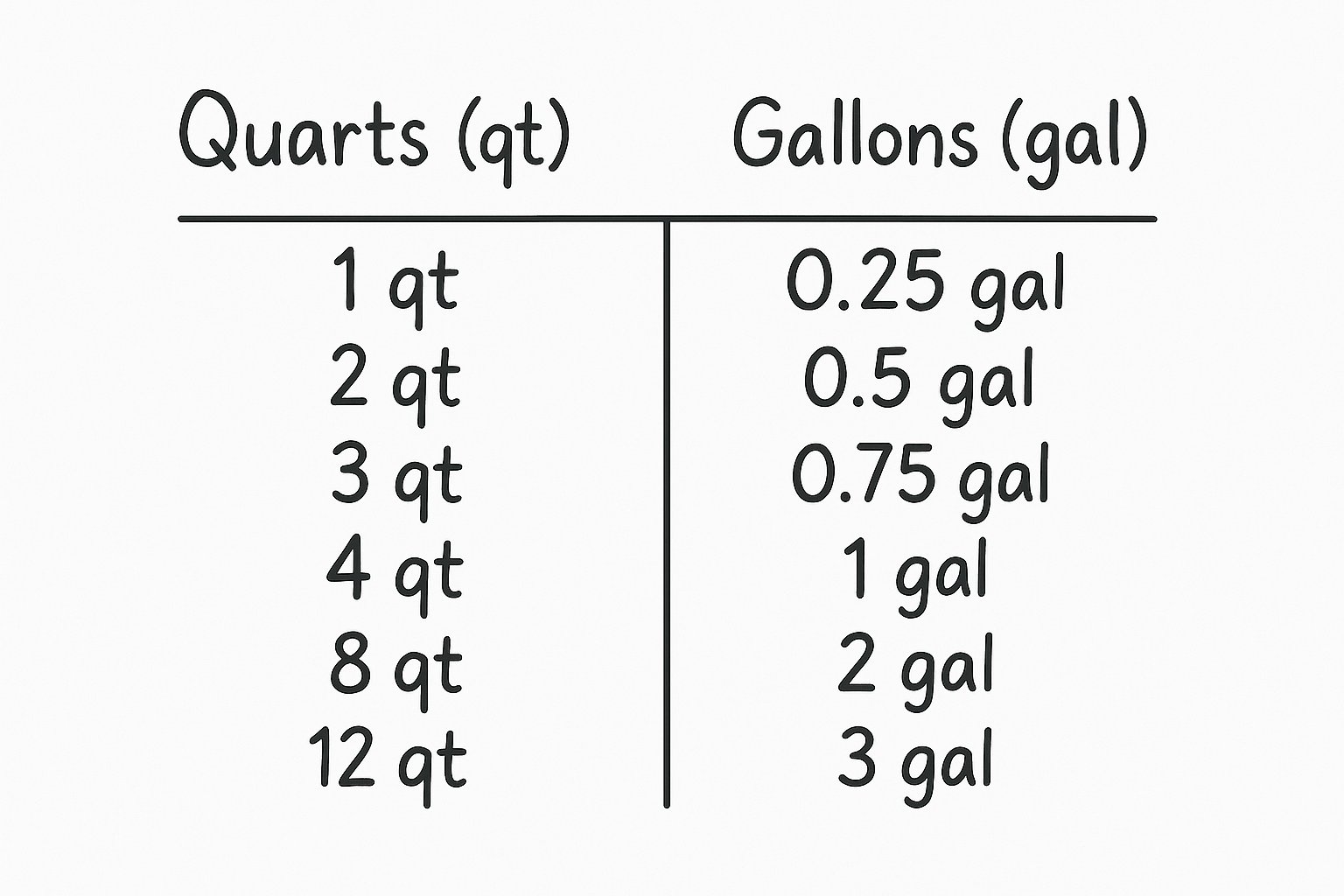
Here’s a straightforward conversion table showing how quarts relate to gallons in the U.S. customary system:
Quarts (qt) | Gallons (gal) |
|---|---|
1 qt | 0.25 gal |
2 qt | 0.5 gal |
3 qt | 0.75 gal |
4 qt | 1 gal |
8 qt | 2 gal |
12 qt | 3 gal |
16 qt | 4 gal |
20 qt | 5 gal |
24 qt | 6 gal |
32 qt | 8 gal |
40 qt | 10 gal |
64 qt | 16 gal |
This table helps visualize how quarts accumulate into full gallons. For example, doubling 8 quarts gives 16 quarts, which equals 4 gallons — useful in cooking, fluid storage, or laboratory settings.
U.S. vs U.K. (Imperial) Conversions
While both systems use the same names, the Imperial (U.K.) gallon is larger than the U.S. gallon because of historical redefinitions.
1 U.S. gallon = 4 U.S. quarts = 3.785 liters
1 U.K. (Imperial) gallon = 4 U.K. quarts = 4.546 liters
This means the U.K. gallon holds about 20% more volume than the U.S. gallon.
Therefore:
1 U.K. quart ≈ 1.136 liters
1 U.S. quart ≈ 0.946 liters
These differences are important in international trade, recipes, and scientific conversions. A gallon of liquid in the U.K. represents a greater volume than the same labeled gallon in the U.S.
Quick Conversion Formula
The relationship between quarts and gallons is expressed with a simple formula:
Gallons = Quarts ÷ 4
And the reverse:
Quarts = Gallons × 4
Example:
If you have 12 quarts, divide by 4:
12 ÷ 4 = 3 gallons
If you need to convert 5 gallons to quarts, multiply by 4:
5 × 4 = 20 quarts
This formula works both ways and doesn’t require advanced math or conversion tools. It’s useful in the kitchen, in industrial fluid measurements, or for educational purposes.
Real-Life Examples
1. Cooking and Baking
Many recipes in the U.S. use quarts and gallons interchangeably depending on quantity. For instance, a milk jug typically contains 1 gallon, which equals 4 quarts.
When scaling recipes, this conversion is helpful:
A 2-gallon soup pot holds 8 quarts.
A 3-gallon beverage dispenser holds 12 quarts.
This understanding simplifies both scaling and storage of liquids.
2. Fuel and Automotive Applications
In automotive and industrial contexts, fluid capacities often appear in both quarts and gallons. Engine oil, for example, may be measured in quarts, while fuel tanks are rated in gallons. Converting between these helps determine how much product is required or how much remains after use.
3. Science and Laboratory Use
While most laboratories use metric units, quarts and gallons still appear in legacy documentation or equipment, especially in the U.S. Converting between them — or to liters — ensures accuracy and consistency across systems.
For instance, to convert U.S. gallons to liters, multiply by 3.785; for Imperial gallons, multiply by 4.546.
4. Household and Gardening Tasks
Mixing fertilizers, cleaning solutions, or paint often requires accurate liquid ratios. For example, a cleaning mixture might call for one quart of concentrate per gallon of water. Understanding how many quarts make up a gallon ensures precise proportions and consistent results.
FAQ: Common Questions About Quarts and Gallons
1. How many quarts are in a gallon?
There are 4 quarts in 1 U.S. gallon.
The ratio is the same in the Imperial system, but each quart and gallon are larger in the U.K.
2. How many gallons are in a quart?
There are 0.25 gallons in 1 quart.
Thus, 4 quarts make 1 gallon, 8 quarts make 2 gallons, and so on.
3. Are U.S. and U.K. quarts the same size?
No. The U.K. quart is larger than the U.S. quart.
1 U.K. quart ≈ 1.136 liters
1 U.S. quart ≈ 0.946 liters
This difference arises because the Imperial gallon contains 4.546 liters, while the U.S. gallon contains 3.785 liters.
4. Why do the U.S. and U.K. systems differ?
The difference dates back to the early 19th century.
The U.S. kept the older Queen Anne wine gallon (based on 231 cubic inches), while the U.K. redefined the Imperial gallon in 1824 based on the volume of 10 pounds of water.
These differing definitions have remained in use ever since.
Conclusion
Understanding how many quarts are in a gallon — and recognizing the difference between U.S. and U.K. systems — is essential for precision in cooking, science, trade, and daily tasks. The key relationships are:
1 U.S. gallon = 4 U.S. quarts
1 U.K. gallon = 4 U.K. quarts
1 U.S. gallon = 3.785 liters
1 U.K. gallon = 4.546 liters
And the simplest conversion rule:
Gallons = Quarts ÷ 4
Quarts = Gallons × 4
These formulas maintain accuracy across systems and help bridge the gap between traditional and metric measurements. Whether used in the kitchen or the lab, understanding this relationship ensures consistent and reliable results every time.